
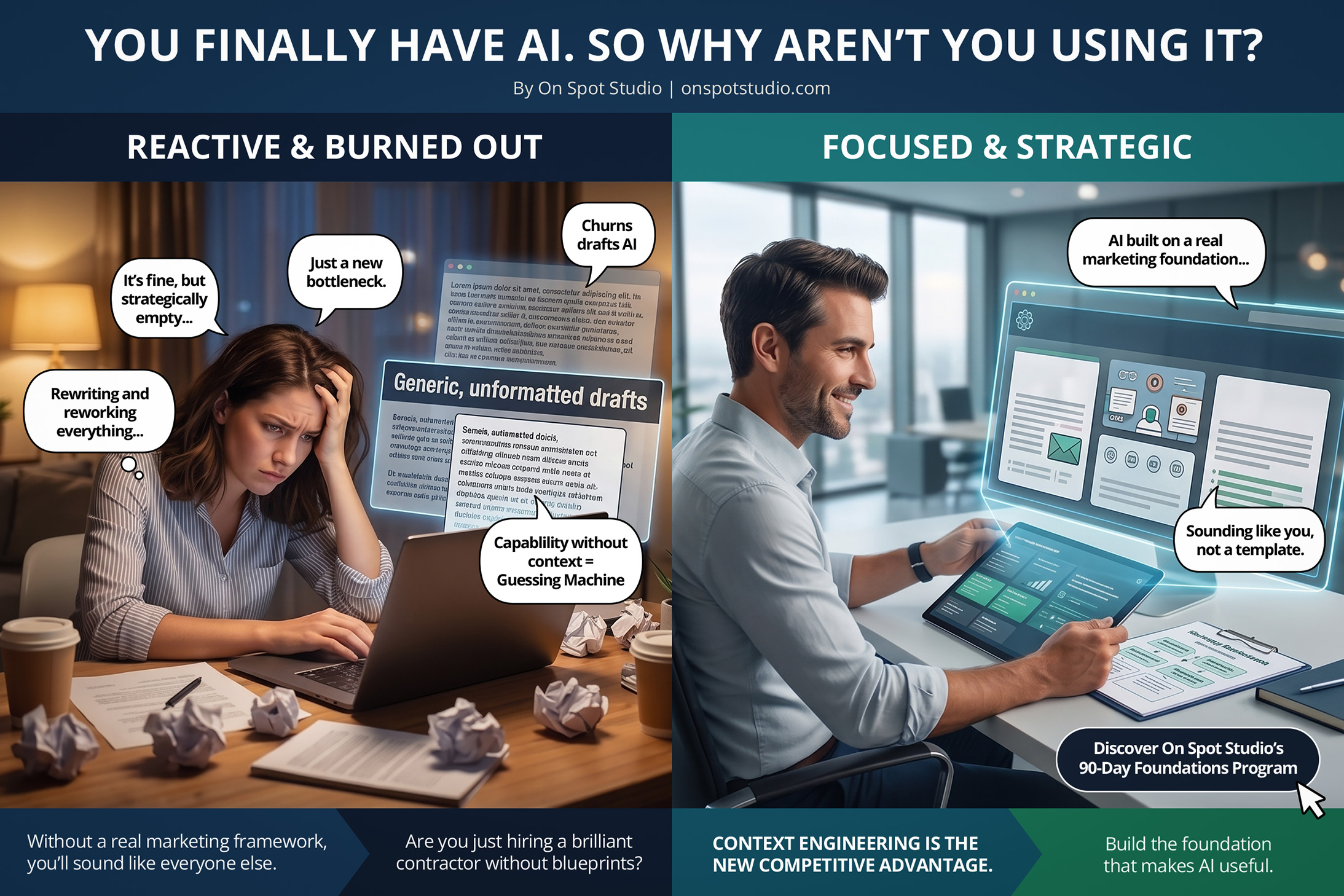
You finally have AI. So why aren’t you using it?
Most small business owners we work with have already crossed the "should we use AI in our marketing?" bridge. They're using it, but it’s not yielding the instant results they were looking for.
And they're burned out.
It’s not because AI isn't capable of delivering some impressive marketing results. It’s because capability without context just makes AI a very fast guessing machine. Without a real marketing framework underneath it, you’ll end up rewriting and reworking most of what your AI agent hands back to you.
That's not leverage for your business. That's just a new kind of bottleneck.
Keep reading this post so we can help you break that cycle. We’ll share our best practices and detail what forward-thinking agencies and platforms have already figured out so that you can leverage AI for your small business right now.
The real problem is the missing foundation.
58% of small businesses now use generative AI, up from just 23% in 2023. According to the U.S. Chamber of Commerce's 2025 annual technology report, this is one of the fastest technology adoption rates ever recorded for this segment. But most are using it reactively. If you’re using AI just to draft a quick email here or generate a caption there, you might not be thinking about the bigger strategy to connect it all.
It's not that those uses are wrong. It's that they're the equivalent of hiring a brilliant contractor and having them show up to a jobsite with no blueprints.
AI needs two things from you to do useful marketing work:
- Context — who your customer is, what you sell, how you talk, what stage of the relationship you're building
- Framework — an understanding of what to say at each step, not just how to say it
Without those two things, you’ll get back plausible-sounding content that could belong to almost any business in your category. While it's technically fine, it's strategically empty. And it certainly won’t deliver content that sets you apart from your competitors.
The truth is, the marketers and agencies who've cracked AI productivity haven't found a better prompt. They've just built better foundations.
Context engineering is the new competitive advantage.
The marketing industry has been buzzing about “prompt engineering,” which is the idea that the way you phrase a request changes the quality of what you get back. That's true, but it has a ceiling. Researchers and practitioners are increasingly pointing to something more fundamental: context engineering.
Think of it this way: two teams using the exact same AI tool with an identical prompt will get dramatically different outputs depending on what context they've built into the system. One team feeds the AI customer personas, historical campaign data, brand voice guidelines, and competitive positioning. The other feeds it the prompt alone. The difference in output quality is massive.
MarTech noted in a recent analysis of the trend: most marketing teams are running AI tools with a fraction of the context needed to make them genuinely useful.
We believe that forward-thinking agencies should be systematizing this for their clients. At On Spot Studio, we create structured “context layers” for our clients that your AI reads before producing anything for your business. Through our real marketing work and experience, we deliver the institutional memory your business needs to thrive in AI. Think of it less as instructions and more as institutional memory. The AI knows who it's talking to, why they buy, what your brand sounds like, and what problem you're actually solving.
Building this context layer is one of the highest-leverage investments you can make as a small business owner doing your own marketing.
AI created a new marketing problem.
For years, the bottleneck in small business marketing was production capacity. There just wasn't enough time to create enough content. AI removed that bottleneck almost overnight, but it created a new one.
Now everyone sounds the same.
AI pulls from the same reference pool for everyone in your niche. And while you can tell it to sound different, its frame of reference is always the same training data, which means it will always default to what already exists in your category.
The result? Content that sounds like all your competitors. Not like you. AI is a master of reconciling the average, and ‘average’ is exactly where you don’t want to be.
So, the fix is not better prompting. It’s giving AI a real foundation built around your specific business, your specific customer, and the positioning that sets you apart. It’s about sounding like you and not like a template.
Do these five things today.
- Build a living business brief your AI can read
Before you write another prompt, build a single document that lives alongside your AI workflow and gets referenced at the start of any meaningful task. This isn't a prompt. It's a foundation document and the equivalent of an onboarding packet for a new marketing hire.
It should include:
- Who your customer is: Not just demographics, but what they're trying to accomplish, what's frustrating them, and the exact language they use to describe their problem
- What you sell and why it matters: Your offers, how they're different, and who each one is for
- Your brand voice: What it sounds like, what it doesn't, examples of both
- Where your customer is in their journey: Are they just discovering you? Evaluating options? Loyal repeat buyers? The right message changes entirely depending on this
- Your current priorities: What are you trying to accomplish this month?
Once this document exists, your AI can stop guessing about your business, you can stop re-explaining yourself, and anyone on your team can run marketing tasks.
- Match the message to the moment
One of the most common AI marketing mistakes is treating every piece of content like it has the same job. An ad for someone who's never heard of you is doing completely different work than an email to someone who bought from you six months ago.
AI can handle this distinction beautifully, but only if you tell it which situation it's writing for. Before generating any piece of content, answer three questions:
- Who is receiving this?
- How much do they already know about us?
- What do we want them to do next?
The businesses producing marketing that feels human and strategic are the ones making those distinctions explicit, every time they prompt.
- Use AI for production, not judgement
This is the line that separates intentional AI use from chaotic AI use. AI is extraordinary at production in drafting, iterating, formatting, scheduling, and personalizing at scale. It’s not a replacement for marketing judgment.
Judgment means deciding which offer to lead with. It means knowing your customer is nervous about price right now and that this isn't the week to push the premium tier. It means understanding that your brand voice has shifted slightly and the AI's training data hasn't caught up. It means catching when something is technically on-strategy, but emotionally off.
Judgment stays with you.
- Automate the repeatable, not the meaningful
AI workflow tools can handle appointment confirmations, invoice follow-ups, social post scheduling, first-draft email sequences, and dozens of other repeatable tasks that have nothing to do with strategy. These are real hours recovered. Use them.
But resist the temptation to automate your way past the interactions that actually build relationships. Take on the personal response to a customer who's frustrated. the handwritten thank-you, and the thoughtful check-in with a long-term client. While AI can draft those things, it shouldn't be automated without a human touch.
The businesses that win long-term with AI are the ones who automate processes, not relationships.
- Build once, leverage many times
The biggest efficiency in AI-powered marketing isn't speed, it's reusability. A strong piece of foundational content (a detailed customer story, a well-researched blog post, a crisp explanation of your core offer) can be transformed by AI into a dozen derivative assets: social posts, email snippets, ad variations, FAQ answers, presentation slides.
The practice to build is: invest real thought in creating high-quality cornerstone content, then let AI do the work of adapting and distributing it. Stop creating from scratch every time.
The honest truth about where most small businesses are.
Most small business owners trying to do their own marketing with AI are stuck in a loop: open AI, explain the job, get something back, rewrite half of it, move on. Repeat tomorrow.
AI without a foundation gives you faster drafts. AI built on a real marketing foundation gives you a functioning system and solid returns. A foundation like that becomes one that your team can run, one that produces strategically sound output from the first prompt, and one that gets better as you feed it more context.
This is exactly the kind of work we do.
We're not an AI tool company. We're a marketing and brand systems studio. In practice, On Spot Studio helps build the marketing foundation that makes everything else in your business, including AI, actually work.
Our 90-Day Foundations Program is specifically designed to create the clarity that's missing in most small business marketing: a defined strategy, aligned messaging, and connected systems. That same clarity is precisely what makes AI useful instead of exhausting.
When we work with clients on their marketing systems, we're building the thing that AI needs to do its job: documented positioning, clear customer profiles, a mapped offer stack, and a brand voice that's consistent enough to train against.
Whether you're a solo founder trying to remove the bottleneck in your own marketing, or a small team that needs to produce more without burning out, the answer starts in the same place: a solid foundation.
Grab our free prompt library.
If you want to put this into practice today, take a look at our free Small Business AI Prompt Library. We put together 20 copy-paste prompts for social posts, emails, ads, and strategy, organized by task with fill-in-the-blank placeholders.
And when you're ready to level up your marketing, On Spot Studio's Marketing Foundations Program is your place to start.
Sources
- U.S. Chamber of Commerce Technology Engagement Center — Empowering Small Business: The Impact of Technology on U.S. Small Business (2025) https://www.uschamber.com/technology/empowering-small-business-the-impact-of-technology-on-u-s-small-business
- MarTech — Context Engineering Is the Real AI Advantage in Marketing (April 2026) https://martech.org/context-engineering-is-the-real-ai-advantage-in-marketing
- Small Business & Entrepreneurship Council — Small Business Technology Use Survey (March 2026) https://sbecouncil.org/2026/03/11/new-sbe-council-tech-use-survey-the-digital-state-of-small-business